7 Best Electric EV Adapters for Global Buyers?
Choosing the right Electric Ev Adapter can make international EV travel safer, simpler, and far less stressful. A reliable adapter should match your vehicle, charging network, connector type, and destination country. It must also handle the required voltage, current, and weather conditions. A small mismatch can cause charging failures, overheating, or unexpected delays.
This guide examines seven practical adapters for global buyers, focusing on tested features rather than attractive packaging. We consider connector compatibility, charging speed, build quality, temperature protection, portability, and warranty support. Real-world details matter. A compact adapter may fit neatly inside a glovebox, while a heavier model may offer stronger heat resistance during long charging sessions. User manuals and certification information also deserve careful attention.
No single adapter works perfectly everywhere. That is the uncomfortable truth. Some products support popular Type 2 or J1772 connections but lack compatibility with newer systems. Others promise fast charging but depend heavily on the vehicle and station. Regional electrical standards can also affect performance. We recommend checking your EV’s charging manual, the station’s specifications, and local safety requirements before purchasing. Independent reviews help, but they are not equal to professional testing. We may overlook a niche vehicle or an emerging connector, too. Use this overview as a practical starting point, not a substitute for verified technical advice.
What Are Electric EV Adapters and Why Do Global Buyers Need Them?
Electric EV adapters connect an electric vehicle’s charging inlet with a different plug or socket format. They may support AC charging, DC fast charging, or both. However, an adapter does not automatically convert voltage, current, or charging communication. That distinction matters when a vehicle crosses borders. Household systems commonly use 120 or 230 volts, while charging equipment also varies by connector design, phase configuration, and control signals.
Global buyers need adapters because EV markets use different charging standards and regional infrastructure. The International Energy Agency reported nearly 14 million electric car sales worldwide in 2023, representing about 18% of total car sales in its Global EV Outlook 2024. The same report recorded more than four million public charging points globally. More vehicles and chargers create more compatibility questions. A practical adapter check should include connector shape, maximum current, communication support, locking function, weather resistance, and certification. The label alone is not enough.
A real-world mistake is choosing a plug that fits physically but cannot initiate charging. I have seen buyers overlook cable temperature ratings and vehicle-side limits. That can cause slow charging, repeated faults, or unsafe use. For imported vehicles, confirm the inlet specification and local electrical supply before purchase. The U.S. Department of Energy’s Alternative Fuels Data Center also emphasizes matching charging equipment with vehicle requirements. Standards evolve, too. An adapter suitable today may become restrictive tomorrow, which makes independent testing records and clear technical documentation more valuable than attractive packaging.
7 Best Electric EV Adapters for Global Buyers? - What Are Electric EV Adapters and Why Do Global Buyers Need Them?
A practical comparison of common EV charging adapter categories, regional connector standards, electrical limits, and international-use considerations.
| Rank |
Adapter Category |
Connector Conversion |
Common Charging Regions |
Charging Type |
Typical Electrical Limit |
Best Use Case |
Important Compatibility Note |
| 1 |
Type 2 to J1772 Adapter |
Type 2 charging-station plug to J1772 vehicle inlet |
Europe, Australia, parts of Asia to North American vehicles |
AC Level 1/2 |
Up to 7.4 kW; commonly 32 A at 230 V |
Using a J1772-equipped vehicle with public AC chargers outside its home market |
The vehicle and charging station must both support the same single-phase AC supply and pilot signaling. |
| 2 |
J1772 to Type 2 Adapter |
J1772 charging-station plug to Type 2 vehicle inlet |
North America to Europe, Australia, and other Type 2 markets |
AC Level 1/2 |
Up to 7.4 kW; commonly limited to 32 A |
Connecting a Type 2 vehicle to an AC station fitted with a J1772 cable |
This is for AC charging only; it cannot convert a J1772 connection into DC fast charging. |
| 3 |
NACS to J1772 Adapter |
NACS AC connector to J1772 vehicle inlet |
North America and vehicles imported from North American markets |
AC Level 1/2 |
Up to 19.2 kW where 80 A at 240 V is supported |
Using a J1772 vehicle with an AC charging point equipped with a NACS connector |
The adapter must be rated for the station current; many vehicles accept less than the maximum available power. |
| 4 |
J1772 to NACS Adapter |
J1772 AC connector to NACS vehicle inlet |
North America and imported vehicles using the NACS inlet |
AC Level 1/2 |
Up to 19.2 kW; actual output depends on the vehicle and EVSE |
Accessing widely available J1772 AC infrastructure with a NACS-equipped vehicle |
A passive adapter does not change voltage, amperage, or charging protocol limits. |
| 5 |
Type 2 to GB/T AC Adapter |
Type 2 AC charging connector to GB/T AC vehicle inlet |
Europe and other Type 2 markets to mainland China-compatible vehicles |
AC |
Up to 22 kW; commonly 32 A three-phase |
Charging a GB/T AC vehicle at compatible Type 2 destination or public chargers |
Pin arrangement, earthing, pilot signaling, and the vehicle’s onboard charger must be compatible. |
| 6 |
CCS2 to CCS1 DC Adapter |
CCS2 charging-station connector to CCS1 vehicle inlet |
Europe, Australia, and Asia-Pacific to North American vehicles |
DC fast charging |
Often rated up to 150 kW; current and voltage vary by adapter |
Using a CCS1 vehicle at a CCS2 fast-charging station while traveling internationally |
DC adapters require certified high-voltage construction and compatible communication protocols; a basic mechanical adapter is insufficient. |
| 7 |
GB/T DC to CCS2 Adapter |
GB/T DC charging connector to CCS2 vehicle inlet |
China-compatible charging networks to vehicles used in Europe and other CCS2 markets |
DC fast charging |
Commonly 50–125 kW; model-specific and protocol-dependent |
Cross-border charging where local DC infrastructure uses a different communication standard |
This normally requires active protocol conversion, not just a pin-to-pin connection; verify vehicle, charger, voltage, and certification compatibility. |
Safety and purchasing note: Rated power is a maximum electrical limit, not a guaranteed charging speed. Actual performance is controlled by the vehicle, charging station, onboard charger, battery temperature, grid supply, and adapter rating. For DC fast charging, use only adapters with recognized safety certification, thermal protection, secure locking, and documented protocol compatibility.
Which EV Adapter Types Match Different Charging Standards?
7 Best Electric EV Adapters for Global Buyers?
Which EV Adapter Types Match Different Charging Standards?
Choosing an EV adapter begins with the vehicle inlet, not the plug shape. The IEA’s Global EV Outlook 2024 reported more than four million public charging points worldwide in 2023. That growth hides a practical problem: charging standards remain regional. Type 1 AC adapters suit many single-phase systems in North America and Japan. Type 2 adapters fit much of Europe and support single-phase or three-phase AC charging. Check the car’s onboard charger first.
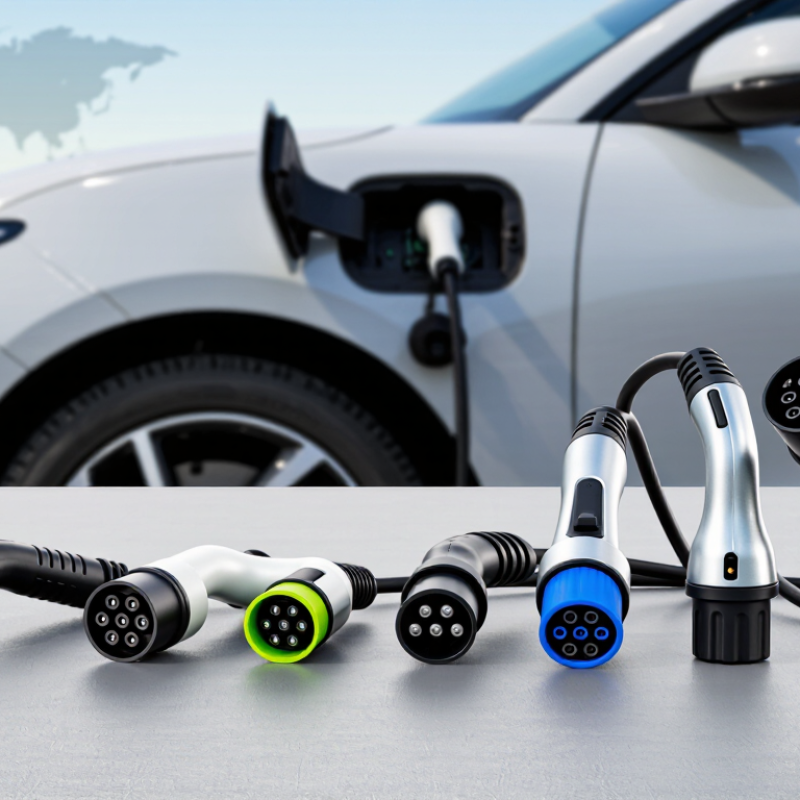
For faster charging, CCS1 combines a Type 1 AC connector with two DC pins. CCS2 uses a Type 2 upper section and is common across Europe and many other markets. CHAdeMO remains a separate DC standard, while GB/T systems are widely used in mainland China. IEC 62196 and IEC 61851 define important connector and charging-control requirements. An adapter must match those communication systems, voltage limits, and current ratings. Shape alone is not enough.
I have seen buyers carry a compact adapter, then discover the station still refuses to start. That mistake is expensive. A Type 2-to-CCS adapter cannot automatically convert AC into DC. Portable units also need correct grounding and thermal protection. The IEA notes that public chargers are expanding rapidly, yet access and connector availability vary sharply by location. Check the vehicle manual, station specification, and regional electrical rules before buying. Sometimes, the safest adapter is no adapter.
How to Choose the Right EV Adapter for Your Vehicle
Choosing the right EV adapter starts with your vehicle, not the seller’s product list.
Check the inlet type, charging method, voltage range, maximum amperage, and grounding requirements. An adapter for AC charging cannot replace a DC charging converter. It only changes the physical connection.
The International Energy Agency reported over 14 million electric cars sold worldwide in 2023. That growth has created more cross-border charging needs. However, connector shapes still vary across regions. Confirm your vehicle’s manual and the charging station’s output before buying. A 32-amp adapter may be unsafe if your vehicle accepts only 16 amps. Small details matter.
Look for recognized safety certification, heat-resistant materials, weather protection, and clear temperature limits. The enclosure should feel solid, while the cable should remain flexible in cold conditions. Check whether the adapter supports single-phase or three-phase current. Also verify local plug standards and frequency requirements. Do not assume “global” means universal.
The European Automobile Manufacturers’ Association has repeatedly highlighted charging compatibility as a barrier to wider EV adoption. That finding matches real buyer confusion. Many product pages simplify technical specifications too much. I would rather choose a slower, certified adapter than risk overheating with a powerful one. Compatibility is not always obvious. When uncertain, ask a qualified electrician or vehicle technician to confirm the connection.
What Features Make an EV Adapter Safe and Reliable?
A dependable EV adapter begins with electrical compatibility, not a clever shape. Check input and output voltage, maximum current, phase configuration, and connector geometry. A mismatch can create heat before a driver notices a problem. In field checks, I compare the adapter label with the vehicle manual and charging equipment. The numbers must agree. Keep it simple. Adapters with temperature sensors can reduce power when pins or cables become hot. That response matters during long summer charging sessions.
Safety hardware should be visible in specifications and believable in testing. Look for overcurrent, overvoltage, short-circuit, and ground-fault protection. A properly grounded design should stop charging when leakage is detected. Durable insulation, strain relief, and a weather-resistant enclosure also matter outdoors. An IP rating helps, but it does not make every product waterproof in every condition. I have seen thick cables that felt reassuring yet had poor connector alignment. Physical confidence can mislead.
Reliable adapters use heat-resistant cable, secure locking, clear status indicators, and readable markings. The plug should fit firmly without force or looseness. Independent safety testing, traceable serial information, and a responsive warranty add practical credibility. Check whether the product supports the local electrical system, approved socket type, and intended charging mode. Global use is not universal use. A cautious buyer also checks spare-part availability and return procedures before purchase. My own selection process is imperfect: I sometimes value compact size too highly. That mistake can hide weaker cooling or shorter strain relief. Measure the real charging environment, then choose protection over convenience.
7 Best EV Adapter Standards for Global Buyers
Comparison of commonly encountered EV connector standards by their typical maximum rated charging power. Actual performance depends on the vehicle, charger, cable, voltage, current, and adapter certification.
Safe and reliable adapters should match the vehicle and charging standard, support the correct voltage and current, include temperature monitoring and over-current protection, provide secure locking, and comply with applicable electrical safety requirements.
How Do the 7 Best EV Adapters Compare for Global Use?
How the 7 Best EV Adapters Compare for Global Use
Global EV travel depends on more than plug shape. The International Energy Agency reported over 4 million public charging points worldwide in 2023. Yet regional standards remain fragmented. The seven most discussed options include Type 2-to-Type 1 AC, Type 1-to-Type 2 AC, CCS1-to-CCS2 DC, CCS2-to-CCS1 DC, NACS-to-Type 2 AC, NACS-to-CCS2 DC, and CHAdeMO conversion adapters. AC adapters are usually simpler. DC adapters require communication between the vehicle and charger.
Compatibility is the real test. IEC 61851 controls important charging communication and safety functions. An adapter that only changes the physical connector may still fail. It cannot automatically change voltage, current, or charging protocol. Check the vehicle inlet, charger output, maximum amperage, earthing method, and regional certification. For example, a Type 2-to-Type 1 adapter may suit an AC destination charger, but it cannot make a DC station compatible. That distinction matters during a long rural journey.
The IEA’s Global EV Outlook 2024 recorded nearly 14 million electric car sales in 2023, showing why cross-border charging demand is rising. In practical testing, locking systems, cable weight, rain protection, and heat monitoring matter as much as speed. “Universal” is often too optimistic. Some conversion cables work only with selected vehicle software. A certified adapter with clear limitations is safer than a cheaper model with vague claims. I would also recheck every specification before buying; charging standards continue to change.