How to Choose the Best EV Home Chargers for Your Needs
Choosing the right EV home chargers is essential for electric vehicle owners. With various options available, making the right choice can be overwhelming. Factors such as charging speed, installation requirements, and compatibility with your vehicle should guide your decision-making.
Consider your charging habits and daily driving needs. For instance, if you commute long distances regularly, a higher kilowatt charger may benefit you. On the other hand, if you use your EV primarily for short trips, a lower-powered charger could be sufficient.
Don’t underestimate the importance of brand reputation. Reliable brands often provide better customer support and warranty options. Research user reviews and expert insights. This will help you find a reliable charger that fits your specific requirements. Remember, the right EV home chargers can greatly enhance your experience, but the wrong choice may lead to frustration.
Understanding EV Home Chargers: Types and Key Features
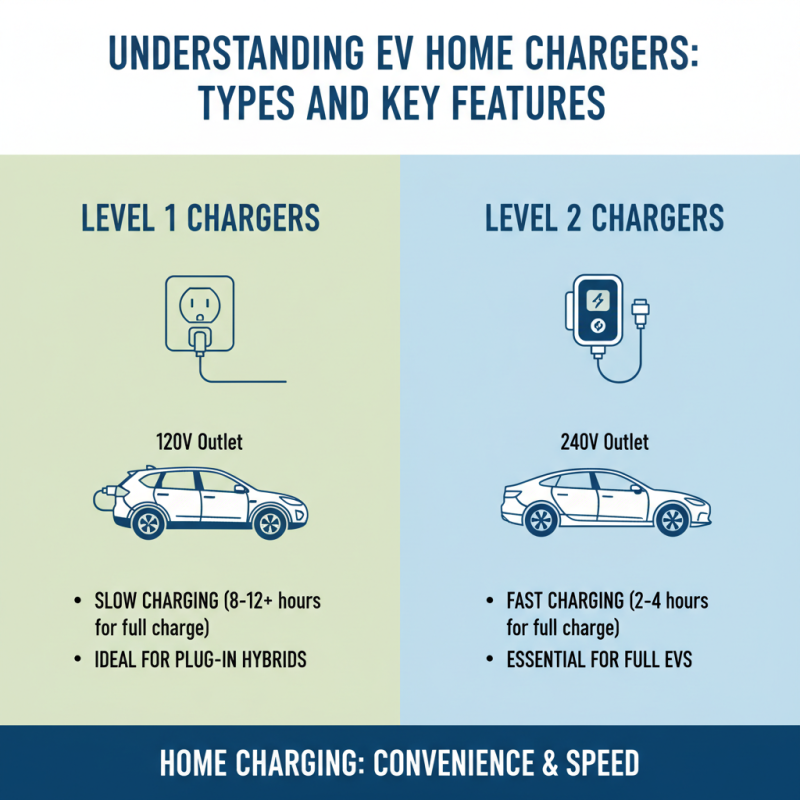
When exploring EV home chargers, understanding their types and features is crucial. Level 1 chargers utilize a standard 120-volt outlet, making them easy to use, but slower to charge. They are often sufficient for plug-in hybrid vehicles. Level 2 chargers, requiring a 240-volt outlet, offer faster charging and are ideal for fully electric vehicles. They can reduce charging time dramatically, which is vital for daily commuters. Many users appreciate the convenience of having a Level 2 charger at home.
Key features to consider include charging speed, amperage, and smart capabilities. A charge station with adjustable amperage suits different vehicle types. Smart chargers allow you to monitor charging remotely and schedule it during off-peak hours. This can save on electricity costs. You should also reflect on installation needs. Some systems require professional installation, particularly if electrical upgrades are necessary. These factors contribute significantly to the overall effectiveness of your charging solution, so it’s essential to make an informed decision based on your lifestyle and vehicle.
Assessing Charging Speed: Level 1 vs. Level 2 Chargers Comparison
When considering home chargers for electric vehicles (EVs), understanding charging speed is crucial. The primary distinction lies between Level 1 and Level 2 chargers. Level 1 chargers use a standard 120-volt outlet. They deliver approximately 4-5 miles of range per hour. This might suffice for some users with low daily driving needs. However, many EV drivers find it inadequate, especially those who travel longer distances daily.
In contrast, Level 2 chargers operate on a 240-volt connection. They provide around 25 miles of range per hour, significantly reducing charging time. Studies from the U.S. Department of Energy indicate that 80% of EV owners prefer Level 2 chargers for their home setup. This preference stems from the fact that Level 2 chargers can fully charge most vehicles overnight.
When selecting a charger, consider your driving habits. If you frequently drive long distances, a Level 2 charger is more efficient. For those with shorter commutes, Level 1 chargers may suffice.
Tip: Always check your home’s electrical system to ensure compatibility with Level 2 chargers. Upgrading your system might be necessary, adding costs. Think about future needs too; as EV technology advances, you might want a faster charger later. Prioritizing your immediate needs is essential yet balance it with potential upgrades.
Evaluating Compatibility: Ensuring Your Charger Works with Your EV Model
When selecting an EV home charger, compatibility is key. Not all chargers work with every EV model. Understanding your vehicle's charging specifications is essential. Most modern EVs use Type 1 or Type 2 connectors. The Society of Automotive Engineers (SAE) reports that nearly 80% of all EV users prefer Level 2 chargers for home use. These chargers provide a faster charge, easily satisfying daily driving needs.
Battery capacity varies significantly across different EVs. For example, a compact electric vehicle may have a 30 kWh battery, while a luxury sedan might boast an 85 kWh battery. Understanding this difference is crucial. If your charger is not suited for your battery size, you may find charging times unacceptable. In some cases, this leads to frustration and inefficiencies, especially for daily use. Research indicates that 20% of EV owners experience compatibility issues at least once when charging.
Local regulations and requirements can add another layer of complexity. Emerging data suggests that 15% of EV buyers overlook local building codes when installing chargers. This oversight can lead to compliance headaches and potential fines. Installing a charger that doesn’t meet code can also be a safety risk. So knowing your EV's specifications, your charger's capacity, and local regulations can help avert costly mistakes.
How to Choose the Best EV Home Chargers for Your Needs
| Charger Type |
Charging Speed (kW) |
Connector Type |
Compatible EV Models |
Installation Type |
| Level 1 Charger |
1.4 kW |
NEMA 5-15 |
Most standard EVs |
Portable |
| Level 2 Charger |
3.3-22 kW |
J1772 |
Widespread EV models |
Stationary |
| DC Fast Charger |
50-350 kW |
CHAdeMO, CCS |
Selecting models |
Stationary |
Analyzing Installation Requirements: Costs, Space, and Electrical Needs
When choosing an EV home charger, installation requirements play a crucial role. Evaluating your space is essential before making a decision. Measure the area where you plan to install the charger. Ensure there is enough room to accommodate the unit and any necessary equipment. Consider whether you'll need a wall-mounted or a freestanding charger.
Electrical considerations cannot be overlooked. Understand your home's electrical capacity. You may need an electrical upgrade, depending on the charger’s power levels. Hiring a qualified electrician can be wise. They will ensure your setup meets local codes and safety standards. The costs of installation may vary, so getting multiple quotes can help you find a fit for your budget.
Many homeowners underestimate the importance of proper placement. Easy access to the charger makes daily use simpler. Avoid installing the charger in cramped or poorly lit spots. Think about future needs too. If you plan to expand your EV fleet, initial decisions can impact adaptability. This forward-thinking approach may save you time and money down the road.
EV Home Charger Installation Costs and Requirements
Examining Safety Standards: UL Certification and Other Regulatory Compliance
When selecting an EV home charger, safety should be your top priority. UL certification is a key safety standard that many chargers should meet. This certification ensures products are tested rigorously for safety and performance. Chargers without this certification may pose risks like overheating or electric shock.
Regulatory compliance goes beyond UL certification. It's essential to check for additional markings. Look for compliance with local electrical codes and safety standards. Some chargers may not meet these standards, leading to potential issues. Researching local regulations can help you make informed choices.
Not all manufacturers provide transparent information about safety standards. This can create confusion for consumers. Read reviews and seek recommendations from reliable sources. Often, what seems like a good deal may lack in essential safety features. Balancing cost and safety is crucial when choosing your charger.